FibroCeram Materials
FibroCeram Materials
FibroCeram Materials
Explore our state-of-the-art ceramic fiber products, engineered for severe high-temperature operations, rapid installation, and unmatched thermal efficiency.
Your Trusted Experts in Industrial Heat Shielding and Energy-Saving Technologies
Henan FibroCeram Advanced Materials Co., Ltd. (globally recognized via our specialized export division, Titan New Material) is a pioneer in the design, development, and high-volume manufacture of advanced aluminosilicate and polycrystalline refractory fibers. Based in Henan Province—the refractory capital of China—we benefit from geographical proximity to premium raw mineral deposits, allowing us to source outstanding quality alumina and silica oxides. This structural advantage, combined with our rigorous, state-sanctioned environmental compliance and advanced double-needle loom processes, positions us as a dominant supplier in the thermal insulation industry.
With decades of chemical research and mechanical experience, our expert engineers develop insulation systems designed to endure intense thermal cycling, corrosive gas erosion, and physical degradation. Our comprehensive product portfolio spans from lightweight ceramic blankets and high-density vacuum-formed boards to custom gaskets, modular fiber blocks, and polycrystalline solutions designed to operate up to 1600°C. By delivering superior energy efficiency and reducing heat loss in high-temperature kilns, we serve as a vital partner in the global drive towards industrial decarbonization.
Engineered for Reliability: Comprehensive Specifications Across Four Advanced Material Categories

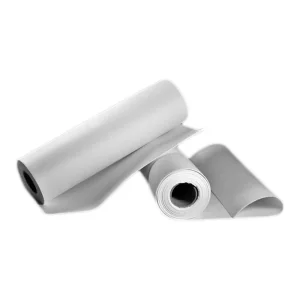
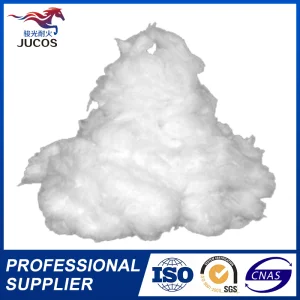
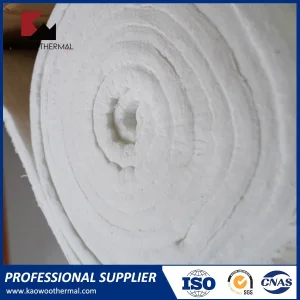
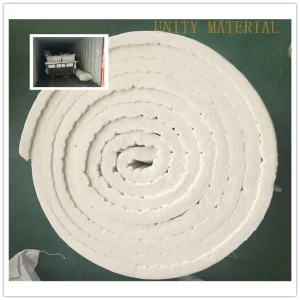
Our spun and blown ceramic fiber blankets feature double-sided needle punching, ensuring high tensile strength before and after heating. They contain no organic binders, preventing toxic outgassing or smoke during initial firing cycles.
| Property | Specification |
|---|---|
| Classification Temp | 1260°C / 1300°C / 1430°C |
| Thickness Range | 6mm to 50mm |
| Density Range | 64 kg/m³ to 160 kg/m³ |

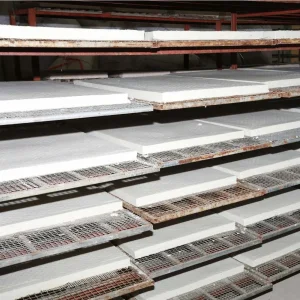
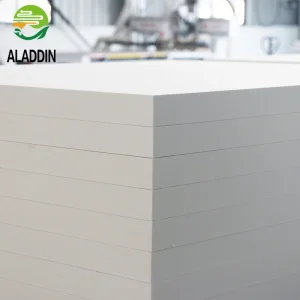
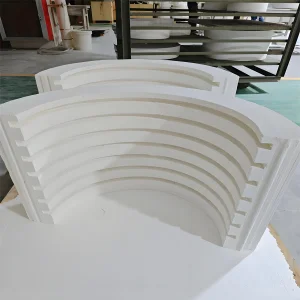
Produced using a vacuum-slurry forming process, our refractory boards are rigid, self-supporting, and designed to resist mechanical stress, high gas velocity, and thermal shock. Easily cut and shaped for furnace linings.
| Property | Specification |
|---|---|
| Classification Temp | 1260°C / 1430°C |
| Thickness Range | 6mm to 100mm |
| Density Range | 220 kg/m³ to 600 kg/m³ |

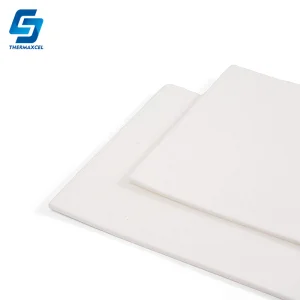
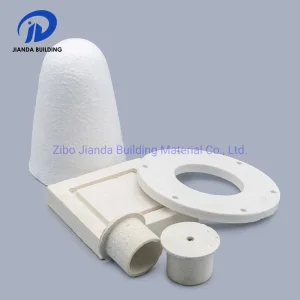
Flexible, highly uniform thermal gaskets made from clean bulk fiber and organic binders. Specially processed to guarantee low shrinkage, structural uniformity, high dielectric strength, and a smooth surface finish.
| Property | Specification |
|---|---|
| Classification Temp | 1260°C Standard / 1350°C High-Al / 1430°C ZrO2 |
| Thickness Range | 1mm to 10mm |
| Density Range | 170 kg/m³ to 220 kg/m³ |

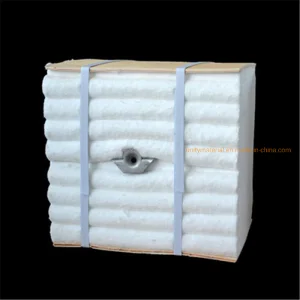
Fabricated from compressed blankets, our modules feature pre-installed Type S, M, or T anchors to simplify furnace lining installations. Once mounted, the bands are cut, allowing the modules to expand and form a seamless, highly insulated refractory surface.
| Classification Temp | Anchor Options | Compressed Density | Structural Designs |
|---|---|---|---|
| 1260°C / 1300°C / 1430°C | S / M / T Stainless Anchors | 160 kg/m³ to 240 kg/m³ | Stack Bonded & Folded Configurations |
Unlocking True Value: Unmatched Supply Chain Speed, Rigorous Testing, and Cost Optimization
Located in Henan, our manufacturing plants have direct access to top-grade, high-purity alumina and silica reserves. Minimizing raw material transport costs allows us to offer premium refractory materials at highly competitive prices.
Our blankets undergo high-intensity, double-sided mechanical needing, which eliminates the need for organic binders. This process produces superior tensile strength and structural integrity, preventing delamination at high temperatures.
Equipped with advanced multi-stage dust collection systems and clean-burning gas kilns, our facility is fully compliant with modern environmental regulations. This guarantees continuous, uninterrupted production even during strict environmental inspections.
Tailored Refractory Engineering for Crucial High-Temperature Environments

Ideal for Regenerative Thermal Oxidizers (RTO), shuttle kilns, rotary kilns, rolling hearths, and muffle furnaces requiring high thermal resistance and low heat storage.
Designed for movable and tunnel kilns producing ceramics and red bricks. Our modules reduce structural weight and heat loss, optimizing fuel consumption.

Provides excellent backing insulation for commercial and domestic wood-fired ovens, ensuring fast heat-up times and constant baking temperatures.
Used as expansion gap joints, tundish covers, investment casting mold wraps, and ladle backings, preventing liquid metal penetration and heat loss.
High-density ceramic fiber blankets and boards serve as lightweight, non-combustible core materials in fire doors, ensuring strict compliance with international fire safety codes.

Used alongside mineral rockwool to wrap high-pressure steam pipes and refinery transfer lines, delivering superior acoustic damping and thermal efficiency.
Evaluating Crucial E-E-A-T Criteria when Sourcing Refractory Fiber Boards from China
When sourcing ceramic fiber insulation boards, global procurement officers must evaluate technical specifications beyond simple price metrics. High-temperature environments expose boards to chemical reduction, gas erosion, and physical degradation. Our manufacturing process focuses on the following quality controls:
We monitor and adjust density configurations from 220 kg/m³ to 600 kg/m³. Selecting the appropriate density is crucial: higher densities improve mechanical durability and resist high-velocity gas erosion, whereas lower densities minimize thermal conductivity and total furnace weight.
Uncontrolled heating causes fibers to shrink and crack. Our QC lab subjects every production batch to rigorous linear shrinkage tests at 1100°C, 1260°C, and 1400°C, ensuring high dimensional stability and minimizing joints separation in the kiln lining.
Most boards use organic binders to enhance green strength for handling and cutting. When heated, these binders burn off, causing temporary smoke. We offer both standard organic-bonded boards and specialized inorganic binders that deliver zero-smoke startups.
Leading the Shift to Next-Gen Bio-Soluble Fibers and Green Production Systems
The global industrial landscape is shifting toward energy efficiency and strict occupational safety. As a leading manufacturer, we invest heavily in R&D to meet these requirements:
Direct Answers from our Technical Director to Common Industry Queries
Browse our complete range of specialized tapes, sealing components, custom modules, and high-purity refractory materials.