FibroCeram Materials
FibroCeram Materials
FibroCeram Materials
Engineered for extreme thermal resistance, mechanical stability, and energy conservation across modern process industries.
The global high-temperature refractory and ceramic fiber industry serves as a crucial pillar for thermal management in modern processing manufacturing. Over the past decade, the demand for high-strength, lightweight, and low-thermal-conductivity materials has accelerated. Industry researchers forecast substantial growth driven by the expansion of critical sectors such as petrochemical refining, metallurgy, power generation, and advanced structural insulation.
SEO Insight & Market Reality: Global supply chains require manufacturers who possess integrated R&D capabilities, stringent control over impurity profiles (specifically Fe₂O₃ and Na₂O levels), and sustainable raw material sourcing policies. Modern thermal solutions prioritize lower mass, faster thermal cycling, and optimized fuel consumption.
Currently, the market is characterized by a transition from traditional Refractory Ceramic Fibers (RCF) toward Alumina-Silicate wools, Polycrystalline Wools (PCW), and bio-soluble Earth Alkaline Silicate (AES) variants. Manufacturers in APAC, specifically China, dominate production capacities, whereas North American and European suppliers focus on specialized processing, customized preformed shapes, and complex environmental compliance engineering.
A Global Benchmark for Advanced High-Temperature Thermal Insulation Systems
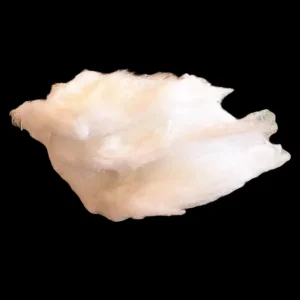
Operating under the brand Titan New Material, Henan FibroCeram Advanced Materials Co., Ltd. is a major ceramic fiber manufacturer in China. Offering an extensive, vertically integrated product matrix, Titan New Material develops, manufactures, and supplies high-performance ceramic fiber blankets, bulk fiber, boards, papers, customized modules, refractory castables, and refractory insulating bricks. Our engineered solutions are designed to address demanding environmental dynamics, structural load limits, and thermal stress patterns.

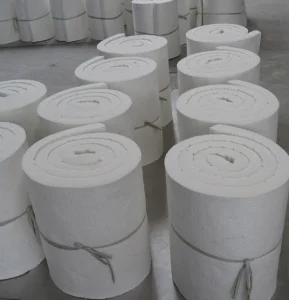
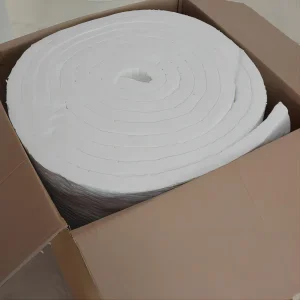
Classified across three distinct temperature thresholds (1260°C, 1300°C, and 1430°C). Thickness ranges from 6mm to 50mm, with densities ranging from 64 kg/m³ to 160 kg/m³. Double-needled process delivers outstanding tensile strength and structural integrity under cyclic thermal exposure.

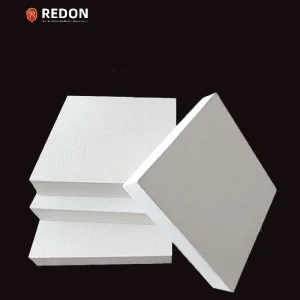
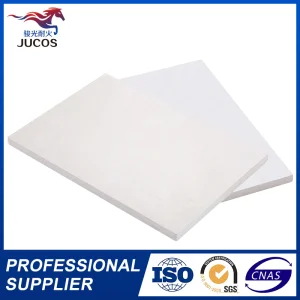
Engineered for low-deformation backline linings, classifying in 1260°C and 1430°C temperature ranges. Available in thicknesses from 6mm to 100mm, with densities spanning 220 kg/m³ to 600 kg/m³. Vacuum-formed processing provides high flexural strength and resistance to wind erosion.

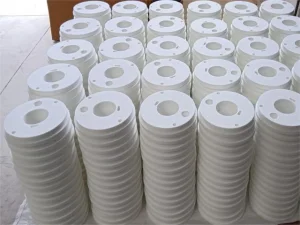
Engineered for precise die-cut gaskets, expansion joints, and battery thermal barriers. Three types: 1260°C Standard, 1350°C High-Alumina, and 1430°C Zirconium Grade. Thicknesses range from 1mm to 10mm; densities vary from 170 kg/m³ to 220 kg/m³.

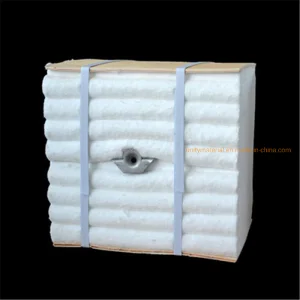
Fabricated from folded or stack-bonded ceramic fiber blankets under continuous compression. Standard densities range from 160 kg/m³ to 240 kg/m³. Pre-equipped with heavy-duty structural anchors (Type S, M, or T) to facilitate quick furnace lining installation and minimize downtime.
Delivering Tailored Refractory Solutions Across Heavy Industrial Processes

Optimal insulation design for Regenerative Thermal Oxidizers (RTO), high-efficiency shuttle kilns, rotary cement kilns, roller hearth kilns, and high-purity laboratory muffle furnaces.
Robust thermal barriers for continuous tunnel kilns and modular movable kilns producing structural clay bricks, advanced technical ceramics, and clay roof tiles.

Food-grade, lightweight, and low thermal mass ceramic fiber insulation wraps that optimize heat retention, accelerate preheat cycles, and ensure safety clearances.
Thermal lining for reheating furnaces, ladle covers, tundish backup linings, soaking pit covers, and expansion seals in steel casting and forging facilities.
High-density ceramic fiber blankets and customized boards integrated into industrial fire protection doors, high-risk enclosure assemblies, and structural firewalls.

High-efficiency protective wraps featuring multi-layered ceramic fiber blankets and Rockwool composites designed to isolate high-pressure steam pipes and petrochemical conduits.
The evolution of high-temperature thermal management materials is driven by three main criteria: reducing carbon footprint, lowering energy consumption, and improving worker safety. The following parameters define the technical developments expected through 2030:
Transitioning from melt-spun amorphous alumino-silicate fibers (stable to 1260°C) to sol-gel derived polycrystalline wools (PCW). These withstand prolonged exposures up to 1600°C–1800°C without significant devitrification or shrinkage.
Developing Earth Alkaline Silicate (AES) fibers using calcia-magnesia-silica chemistry. These exhibit low biopersistence and dissolve quickly in human lung fluids if inhaled, ensuring compliance with strict environmental regulations like REACH.
Integrating silica aerogels into conventional ceramic fiber matrices to produce hybrid insulation blankets. This halves thermal conductivity at moderate temperatures (200°C–600°C) compared to standard fiber structures.
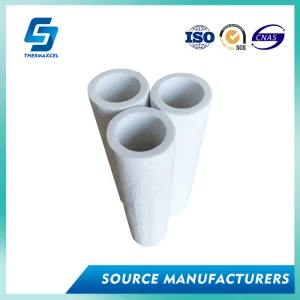
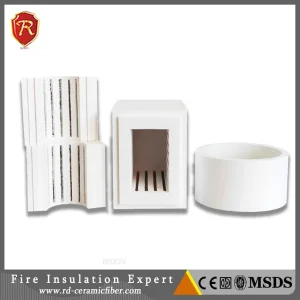
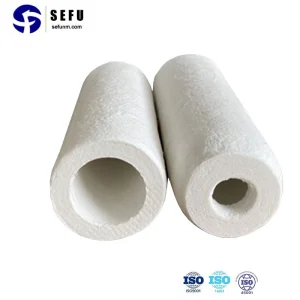
Additionally, modern manufacturing uses smart energy monitoring systems inside raw materials calcination processes and automated vacuum-forming lines. This ensures uniform density profiles, smooth surfaces, and high dimension precision for customized vacuum-formed components like tubes, chambers, and burner blocks.
Addressing the Technical and Operational Inquiries of Refractory Engineers
The differences lie in the raw chemical composition. Standard 1260°C grade fibers are manufactured using high-purity alumina-silica sand. The 1300°C grade features higher alumina content (Al₂O₃ ≥ 45%). The high-performance 1430°C grade incorporates Zirconium Oxide (ZrO₂ ≥ 15%) into the melt, which inhibits recrystallization, increases the activation energy of devitrification, and reduces linear shrinkage during continuous high-temperature exposure.
Ceramic fiber blankets consist of an interwoven network of long, flexible fibers containing up to 90% air porosity. The tiny pores restrict gas convection currents within the blanket, while the minimal contact area between the fibers reduces solid heat conduction pathways. This combination results in a low thermal conductivity profile (down to 0.09 W/m·K at 600°C for 128 kg/m³ density).
Devitrification is the phase transformation from an amorphous, glassy structure to a crystalline phase (typically mullite or cristobalite) under prolonged exposure to temperatures above 950°C. This crystallization makes the fibers brittle and causes shrinkage, reducing their mechanical elasticity and thermal shock resistance.
Modules are pre-compressed during fabrication. When installed in a furnace, the binding straps are cut, allowing the modules to expand laterally. This compression compensates for thermal shrinkage and seals joints. Utilizing underlying backup blankets, offset joints, and high-alloy anchors (such as SS310 or Inconel 601) helps prevent hot-gas bypass to the furnace shell.
Vacuum-formed parts require organic binders (like starch or latex) for green-strength handling. On initial heating, these organic binders burn out, typically between 150°C and 350°C, which may generate minor smoke and odor. This burnout does not compromise the structural integrity of the inorganic alumina-silicate fiber matrix, which remains stable up to its classification temperature limit.
Engineered insulation solutions, custom vacuum-formed shapes, and high-bulk fibrous materials.