FibroCeram Materials
Refractory insulation materials protect furnaces, kilns, reactors, and heat-treatment equipment from extreme temperatures. Their processing quality directly affects thermal efficiency, service life, and plant safety. The World Steel Association reported approximately 1.89 billion tonnes of crude steel production in 2023. This scale highlights the importance of reliable refractory manufacturing across energy-intensive industries. The International Energy Agency also identifies industrial heat efficiency as a major pathway for reducing energy demand and emissions.
To Improve processing performance of refractory insulation materials, manufacturers must control more than raw material selection. Particle size distribution, fiber dispersion, moisture content, binder dosage, mixing time, and forming pressure all influence the final structure. A slight moisture variation can create pores, cracks, or uneven drying. Small details matter. Practical experience shows that operators often correct defects after forming, although earlier process monitoring is usually more effective.
The U.S. Department of Energy’s Industrial Decarbonization Roadmap emphasizes process optimization, waste reduction, and improved thermal performance. These priorities apply closely to refractory production. Better batching systems can reduce material variation. Controlled drying can limit shrinkage. Accurate firing profiles can improve strength without excessive energy use. However, no single adjustment solves every production problem. A formula that works in a laboratory may fail beside a fast-moving production line. This introduction examines practical ways to improve mixing, forming, drying, firing, inspection, and process documentation. It also considers an uncomfortable issue: some plants measure final defects carefully but monitor the earlier causes poorly. Reliable improvement begins with clearer data, repeatable procedures, and honest review of what the process still gets wrong.
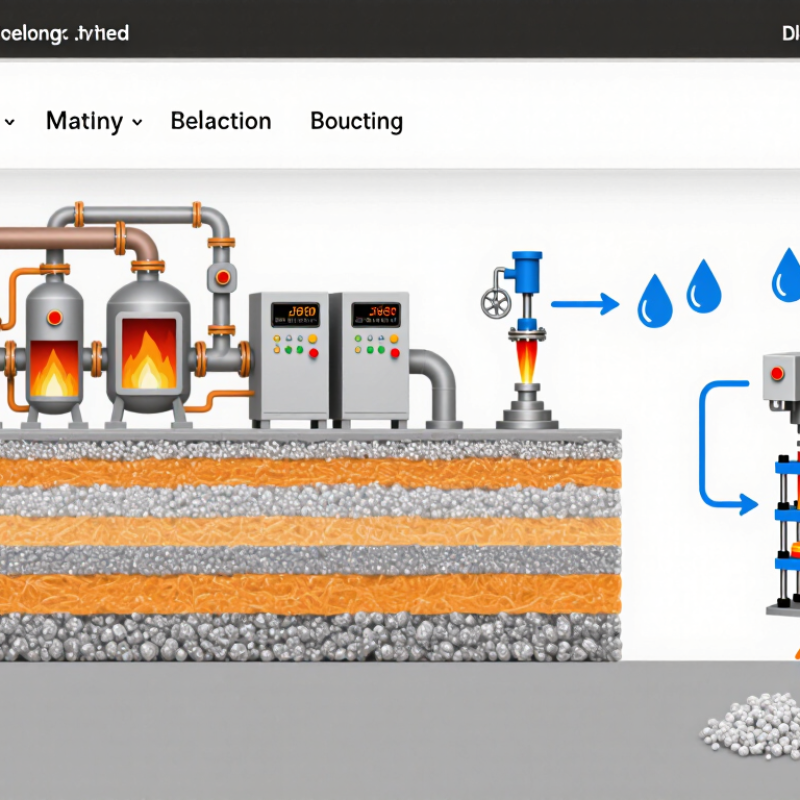
Top Ways to Improve Refractory Insulation Material Processing
Refractory insulation materials reduce heat loss in furnaces, kilns, and high-temperature chambers. Common forms include insulating firebrick, ceramic fiber, and lightweight castables. Each material has a different pore structure, binder system, and temperature limit. These differences control how the material should be mixed, shaped, dried, and fired. The main processing goal is not simply lower density. It is balanced performance: low thermal conductivity, reliable strength, stable dimensions, and resistance to chemical attack.
Processing begins with consistent raw materials and accurate moisture control. Excess water may create cracks during drying. Insufficient water can leave weak, poorly bonded areas. Mixing time matters. Uneven mixing often produces hard spots beside fragile zones. During forming, controlled pressure helps create uniform density without crushing useful pores. Drying should proceed gradually, especially near corners and thin sections. Temperature records should be kept throughout firing. Small changes in heating rate can alter shrinkage and final porosity. Quality checks should include bulk density, cold crushing strength, thermal conductivity, and visible cracking. A lower-density sample may insulate better, but it may fail under vibration or handling. That trade-off is easy to underestimate. Better processing comes from measured trials, documented results, and honest review of failures.
Selecting raw materials determines whether refractory insulation survives heat, pressure, and repeated cycling. The U.S. Department of Energy’s Industrial Decarbonization Roadmap reports that process heating consumes about 51% of industrial energy use. Thermal efficiency therefore starts with material chemistry, not only furnace design.
High-alumina aggregates improve hot strength and resistance to chemical attack. Lightweight aluminosilicate aggregates reduce bulk density and heat storage. The trade-off is real. More pores usually lower thermal conductivity, but they can reduce crushing strength. Screen particle size carefully. A balanced grading curve improves packing and limits drying cracks. Calcium aluminate cement can add green strength, although excessive cement may increase shrinkage and thermal conductivity.
Measure before scaling production. ASTM C20 supports testing apparent porosity, water absorption, and bulk density. ASTM C177 provides a recognized method for steady-state thermal conductivity. Practical screening should compare density, cold crushing strength, and conductivity at the intended service temperature. The International Energy Agency’s Energy Technology Perspectives 2023 also highlights efficiency gains from reducing industrial heat losses. Small gains matter.
We often over-trust density alone. That is a mistake. A low-density castable may fail around anchors or edges. Raw materials should be checked for moisture, impurities, particle stability, and thermal expansion. Pilot batches reveal problems that spreadsheets miss. One overlooked detail is enough.
| Raw Material or Additive | Primary Function | Typical Bulk Density Range (kg/m³) |
Typical Thermal Conductivity (W/m·K) |
Strength and Processing Contribution | Recommended Processing Focus |
|---|---|---|---|---|---|
| Alumina Powder | High-temperature structural phase and refractory filler | 2,800–3,900 True density |
0.8–2.5 Porous body, temperature dependent |
Increases hot strength, refractoriness, and abrasion resistance. Excessive loading can raise density and thermal conductivity. | Control particle-size distribution, use a bimodal grading, and optimize water or binder content to limit shrinkage and porosity defects. |
| Mullite Aggregate | Low-expansion structural aggregate for insulating castables and boards | 400–1,200 Product dependent |
0.15–0.45 Near 800°C, porous products |
Provides a useful balance of thermal stability, moderate density, dimensional stability, and mechanical strength. | Use graded particles and sufficient mixing energy to improve packing without destroying the designed pore structure. |
| Lightweight Aluminosilicate Aggregate | Density-reducing aggregate for insulating refractory bodies | 300–900 Product dependent |
0.10–0.35 Near 800°C, porous products |
Reduces thermal mass and heat flow while retaining better temperature resistance than many non-ceramic fillers. | Minimize aggregate breakage during mixing, use low-shear processing where appropriate, and avoid over-vibration. |
| Alumina-Silica Ceramic Fiber | Low-density insulating reinforcement and thermal barrier | 96–192 Bulk fiber form |
0.08–0.20 Approximately 600–1,000°C |
Produces very low thermal conductivity and low heat storage. Fiber addition can improve crack resistance but may reduce compressive strength if overused. | Disperse fibers gradually, prevent balling, and combine with a suitable binder or fine matrix to improve green strength. |
| Calcium Silicate Powder or Board Grade | Microporous insulation phase for low-to-medium temperature zones | 200–320 | 0.055–0.095 Typically near 200°C |
Offers low thermal conductivity and low density. It is sensitive to mechanical damage and may lose performance when exposed to moisture. | Maintain dry storage, use controlled drying, and protect the final product from water absorption during handling and installation. |
| Perlite Aggregate | Lightweight pore-forming aggregate | 80–250 | 0.045–0.10 Near room temperature |
Strongly reduces density and thermal conductivity. Its porous particles can crush under intensive mixing or high compaction pressure. | Use gentle mixing, limit residence time in high-shear equipment, and select particle grading according to the target density. |
| Vermiculite Aggregate | Lightweight, thermally insulating and expansion-resistant filler | 90–250 | 0.06–0.12 Near room temperature |
Provides low density and good insulation. Excessive compaction can collapse its layered structure and reduce insulation efficiency. | Use low-pressure forming, avoid excessive mechanical agitation, and control moisture to improve dimensional consistency. |
| Colloidal Silica or Silica Sol | Low-cement or cement-free binder system | 1,000–1,300 Liquid density |
Matrix dependent | Can improve green strength and reduce cement-related impurities. It may also support lower-temperature drying compared with some hydraulic binders. | Control pH, solids content, gel time, and drying rate. Avoid rapid drying that can create surface cracking or internal moisture gradients. |
| Fine Reactive Alumina | Matrix densifier and sintering aid | 3,500–3,950 True density |
Matrix dependent | Improves particle packing, fired strength, and resistance to slag penetration. Too much fine powder can increase water demand and drying shrinkage. | Optimize the fine-to-coarse ratio, use dispersants when compatible, and verify flowability before increasing solids content. |
| Organic Pore Former | Controlled pore creation for lower density and thermal conductivity | Variable | Lower after burnout | Creates designed pores that reduce heat transfer. Poor burnout control can cause cracking, bloating, or residual carbon. | Match particle size and addition level to the desired pore structure, then use a staged drying and burnout schedule with adequate ventilation. |
| Indicative engineering ranges only. Actual density, strength, thermal conductivity, and service temperature depend on composition, particle grading, forming pressure, porosity, firing schedule, moisture, and test method. Thermal conductivity values are not directly comparable unless measured at the same temperature and density. | |||||
Reliable refractory insulation begins with disciplined mixing. The World Steel Association reported 1.892 billion tonnes of crude steel production in 2023. That scale increases demand for consistent furnace linings and insulation components. The U.S. Geological Survey estimated global magnesite mine production near 28 million tonnes in 2024. Small formulation errors can affect large production volumes. Control moisture, particle grading, and binder temperature before charging the mixer. Shorter mixing cycles are not always better.
Use staged addition rather than dumping every ingredient together. Coarse grains should disperse before fine powders enter the batch. Monitor torque changes during mixing. A steady torque curve often indicates improved distribution. However, torque alone can mislead operators. Material temperature and actual moisture still require direct checks. This is where plant experience matters. Trial batches should record density, flow, and setting time.
Forming pressure must match the material’s plasticity. Excessive pressure can create hidden lamination or uneven density. Insufficient pressure leaves weak edges and open pores. During shaping, maintain consistent die filling and remove trapped air carefully. ISO 1927 guidance supports controlled testing of unshaped refractory materials, but laboratory results cannot replace production trials. Our first setting is rarely perfect. Review rejected pieces by location, not only by defect type. Edge cracks may indicate die friction, while center voids often suggest poor filling or venting.
Consistent refractory insulation begins with controlled moisture removal. Uneven drying can create hidden steam pockets, surface cracks, or weak internal zones. Measure moisture before loading each batch. Record room temperature, humidity, material thickness, and drying time. Small changes matter.
Use a gradual temperature ramp during drying, especially for thick or dense shapes. Keep airflow steady, but avoid strong drafts across exposed surfaces. A practical approach is holding the material at a moderate temperature before increasing heat. Thermocouples should monitor both the chamber and the coldest product area. The displayed furnace temperature may not represent the core condition.
Firing requires the same discipline. Follow a tested heating curve, with slower ramps near critical water-release and binder-burnout ranges. Add a dwell period when internal temperatures lag behind the furnace reading. Inspect fired pieces for warping, color variation, and fine cracking. I once treated a stable surface as proof of complete drying; later testing showed excess moisture inside the batch. That mistake reinforced the value of core measurements. Do not rush it. Cooling also deserves control, because sudden temperature changes can damage newly formed ceramic bonds. Record every cycle and compare results with strength, density, and thermal conductivity tests.
Finished-product quality begins with evidence, not appearance. A smooth refractory board may still contain hidden pores, microcracks, or uneven firing. ASTM C20 measures apparent porosity, water absorption, and bulk density. ASTM C133 evaluates cold crushing strength. These tests reveal weaknesses that visual inspection often misses.
Sampling should cover different kiln positions, batches, and cutting areas. Technicians can record density, dimensions, moisture, thermal conductivity, and strength for every production lot. A 2-millimeter thickness variation can create uneven heat transfer in a furnace wall. That small error matters. Process data should be linked to each finished product, including firing temperature, holding time, and cooling rate. The International Energy Agency reported that industry uses nearly 40% of global final energy in recent assessments. Better insulation processing can therefore support measurable energy savings, although testing alone cannot guarantee field performance.
Statistical process control can identify drift before rejection rates increase. Track averages, ranges, and outliers weekly. Microscopy can confirm whether cracks formed during pressing, drying, or firing. Yet, some plants still rely too heavily on final inspection. That habit deserves reconsideration. A failed product may reflect an earlier process problem, not careless packing. The U.S. Department of Energy’s Industrial Decarbonization Roadmap highlights process heat as a major industrial energy challenge. Manufacturers should combine laboratory results with furnace trials, installation feedback, and periodic calibration. Improvement is rarely perfect. Even a strong test program needs honest review.
Applying quality testing and process improvements to finished products helps reduce defects, stabilize thermal performance, and improve production consistency.
The chart presents a practical priority score for key quality-control activities in refractory insulation processing. Higher scores indicate areas that typically require more consistent monitoring because they strongly influence finished-product performance.
Check moisture, particle grading, and binder temperature before charging the mixer. Small formulation errors can spread across large production volumes. Do not rush.
Add coarse grains first, then introduce fine powders. This sequence supports more even dispersion. Dumping everything together may create hidden rich or lean areas.
No. A steady torque curve can suggest good distribution, but it may mislead operators. Check material temperature and actual moisture directly.
Record density, flow, setting time, and batch conditions. These details help compare small changes. Plant experience still matters.
Excessive pressure may create hidden lamination or uneven density. Low pressure can leave weak edges and open pores. The correct pressure depends on material plasticity.
Edge cracks may point to die friction. Center voids often suggest poor filling or trapped air. Review defects by location, not only by category.
A smooth board may still contain pores, microcracks, or uneven firing. Measure density, dimensions, moisture, thermal conductivity, and strength. Appearance is not proof.
Link test results with kiln position, batch number, cutting area, firing temperature, holding time, and cooling rate. Track averages, ranges, and outliers weekly. Final inspection alone deserves reconsideration.
Use microscopy to identify cracks formed during pressing, drying, or firing. Combine laboratory tests with furnace trials and installation feedback. Our first setting is rarely perfect.
Improving refractory insulation material processing begins with a clear understanding of the required insulation, strength, density, thermal stability, and service-life targets. Carefully selected raw materials, including suitable mineral components, binders, and additives, help create a balanced formulation. Consistent weighing, thorough mixing, and well-controlled forming or shaping procedures are also essential for reducing defects, improving uniformity, and achieving the intended structure. These steps can significantly Improve processing performance of refractory insulation materials while supporting reliable production.
Drying and firing require precise control of temperature, heating rate, atmosphere, and holding time to prevent cracking, deformation, or uneven bonding. After firing, finished products should be tested for dimensions, density, strength, thermal conductivity, porosity, and resistance to thermal shock. Reviewing test results and production records allows manufacturers to identify process variations, adjust formulations or operating conditions, and establish continuous improvements. A systematic approach from material selection through final inspection helps deliver stable quality and dependable insulation performance.
