FibroCeram Materials
FibroCeram Materials
FibroCeram Materials
In the modern era of industrial thermal management, Ceramic Fiber Cloth has emerged as the cornerstone for high-efficiency heat insulation. As a premier Ceramic Fiber Cloth Supplier & Exporter, we have observed a paradigm shift in how global industries approach refractory materials. No longer is heat resistance the only metric; energy conservation, environmental sustainability, and durability under extreme thermal cycling are now the primary drivers of demand.
From the bustling petrochemical complexes in the Middle East to the high-tech semiconductor clean rooms in East Asia, Ceramic Fiber Cloth serves as a critical protective barrier. Globally, the market is expanding at a CAGR of nearly 7.5%, driven by the transition from traditional asbestos-based textiles to safer, high-performance ceramic alternatives. This growth is particularly evident in the European and North American markets, where stringent safety regulations and energy-efficiency standards (such as Carbon Border Adjustment Mechanisms) are forcing factories to upgrade their insulation systems with advanced textiles that can withstand temperatures exceeding 1260°C.
Our manufacturing process integrates the latest AI-monitored weaving technology, ensuring that every square meter of cloth meets precise density and tensile strength requirements. Global procurement teams from sectors like shipbuilding, aluminum smelting, and power generation increasingly look for products that offer a balance of flexibility and mechanical strength.
To meet these specific needs, we provide Ceramic Fiber Cloth reinforced with either Stainless Steel (SS) Wire for extreme durability or E-Glass Fiber for electrical resistance. This customization allows our clients to optimize their procurement for localized application scenarios, whether it's for insulation curtains in a rotary kiln or fire protection wraps for marine engine exhausts.
The industry is moving toward Bio-Soluble Ceramic Fiber Cloth. These products are engineered for lower persistence in the human body, meeting the strictest HSE (Health, Safety, and Environment) requirements without sacrificing thermal performance. We are leading this trend by providing AES (Alkaline Earth Silicate) fiber products to the global market.
Standard cloth is being replaced by Coated Ceramic Textiles. Vermiculite, Aluminum Foil, and Silicone coatings are being applied to increase abrasion resistance, heat reflectivity, and chemical stability. Our high-temperature aluminum foil laminated cloth is a prime example of this innovation.
With the rise of "Industry 4.0", ceramic fiber cloth is being used as a substrate for flexible thermal sensors. This allows industrial operators to monitor heat loss in real-time, integrating traditional refractory materials into the digital ecosystem of a smart factory.
Understanding the local environment is key to material selection. In coastal industrial zones, corrosion resistance is paramount; hence our SS316 wire-reinforced cloths are highly sought after. In metallurgical hubs, where molten metal splashes are common, our vermiculite-treated cloths provide superior protection.
As a specialized Ceramic Fiber Cloth Exporter, we offer consultation services to help engineers choose the right weave—whether it's plain weave for general sealing or twill weave for complex shapes. Our products are widely used in expansion joints, welding blankets, and oven door seals across five continents.
The global supply chain for refractory materials heavily relies on China, and for good reason. As a leading manufacturer, Henan FibroCeram Advanced Materials Co., Ltd. represents the pinnacle of Chinese industrial expertise. Our advantages include:
Thermal Insulation Material Experts
Titan New Material is a major ceramic fiber manufacturer in China. We offers ceramic fiber blankets, bulk fiber, boards, papers, modules, refractory castables, refractory bricks, etc.

Classified into 1260C, 1300C, 1430C. Thickness 6mm-50mm.

Temps 1260C/1430C. Densities up to 600kg/m3.

High-aluminum and ZrO2 types available. 1mm-10mm.

Folded & Stack bonded. Pre-installed S/M/T anchors.
Our ceramic fiber products are widely used across multiple high-stakes industries.
RTO incinerator, shuttle kilns, rotary kilns, muffle furnaces.
Tunnel kilns for ceramics and red bricks production.

Premium food-grade thermal insulation for residential and commercial ovens.
Essential refractory components for continuous casting and smelting.
High-density core materials for fire-rated safety doors.
Energy-efficient thermal wrapping for industrial piping systems.
When a procurement manager searches for a Ceramic Fiber Cloth Supplier & Exporter, they are looking for technical data that supports long-term reliability. Ceramic fiber cloth is made from spun ceramic fiber, which is blown or spun from melted alumina-silica. This base material is then blended with a percentage of organic carriers (usually around 15%) to facilitate the weaving process. These carriers "burn off" at approximately 200-300°C during initial use, which may cause some slight smoke, but does not affect the ultimate refractory properties of the cloth.
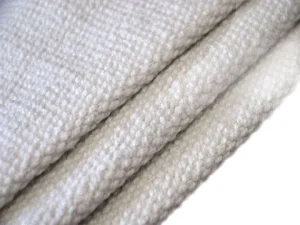
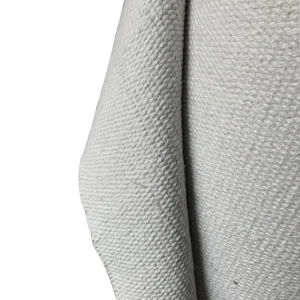
The weave structure is critical. Plain weave is the most common, providing a stable, balanced cloth that is easy to cut and sew. Twill weave, on the other hand, provides a denser textile that is more resistant to fraying—ideal for high-vibration environments like ship engines. For specialized gaskets, satin weave can be employed for maximum smoothness.
Unreinforced ceramic cloth has limited tensile strength. This is why reinforcements are vital:
1. Glass Fiber Reinforcement: Used for applications up to 650°C. It is cost-effective and provides excellent electrical insulation.
2. Stainless Steel (SS) Wire: Usually 304 or 310 grade. It allows the cloth to maintain its structural integrity up to 1260°C, even as the organic fibers burn away. This is the gold standard for industrial heat curtains and furnace door seals.
One of the greatest advantages of our ceramic fiber cloth is its resistance to chemical attack. It is virtually unaffected by most acids, alkalis, and solvents, with the exception of hydrofluoric acid, phosphoric acid, and strong alkalis. This makes it an indispensable asset in the petrochemical industry, where textiles must survive in highly corrosive atmospheres near refineries and chemical processing units.
Purchasing from a reliable Ceramic Fiber Cloth Exporter like Henan FibroCeram isn't just about safety; it's about the bottom line. Low-quality cloth often suffers from "delamination" or rapid degradation of the reinforcing wire, leading to frequent maintenance shutdowns. Our high-grade textiles can extend the service life of furnace linings by up to 30%, resulting in significant cost savings over a three-year operational cycle.